
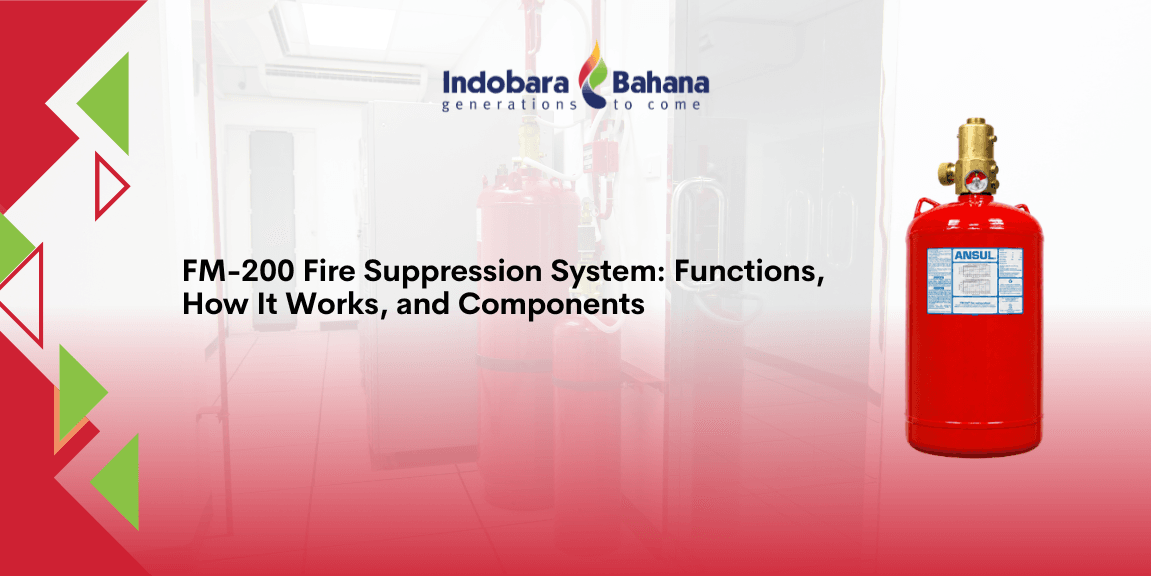
The FM-200 Fire Suppression System is a clean agent solution used to protect electronic equipment and high-value assets. In server rooms, communication centers, or control rooms, choosing the right extinguishing agent is important because particles and oily deposits can increase cleanup requirements and interfere with the protected equipment.
This system uses a gaseous clean agent distributed through a fixed piping network and nozzles. When the system activates, it discharges the extinguishing agent into the protected area. The agent suppresses fire without leaving residue or oily deposits on sensitive electronic equipment.
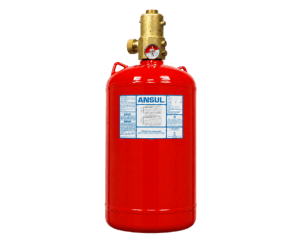
FM 200, also written as FM-200 or FM200, is a total flooding fire suppression system that uses HFC-227ea as its extinguishing agent. According to the ANSUL data sheet, this is an engineered system. Designers must tailor it to the conditions of each protected area. A piping network and fixed nozzles distribute the agent at a flow rate calculated for the specific fire hazard.
Unlike a fire extinguisher that is manually directed at a single point of fire, the FM-200 Fire Suppression System operates as an integrated system. It includes an agent storage container, a detection system, a control panel, a piping network, nozzles, and actuation devices. Manual or automatic actuators can discharge the agent, depending on the system design.
When properly designed and installed, FM-200 can suppress surface fires involving Class A, B, and C hazards. The data sheet also states that designers and installers must follow NFPA 2001, the standard for clean agent fire extinguishing systems.
The FM-200 agent is HFC-227ea, a clean gaseous agent that contains no particles and leaves no oily residue. These characteristics make it relevant for areas containing electronic equipment or critical assets that should not be exposed to extinguishing media that leave contaminants behind.
The ANSUL system stores the agent in a high-pressure steel container equipped with a valve and an internal siphon tube. Dry nitrogen pressurizes the agent inside the container to 360 psi at 70 °F, or approximately 25 bar at 21 °C. The nitrogen supports the storage and delivery of the agent through the system’s piping network during discharge.
According to the ANSUL data sheet, production of the FM-200 agent takes place in an ISO 9000 environment and follows ISO 9001 guidelines. Strict manufacturing specifications help maintain product purity. The agent is thermally and chemically stable.
The primary function of the FM-200 Fire Suppression System is to suppress fire within a protected area while helping reduce the risk of additional damage caused by extinguishing-agent residue. The piping network carries the gaseous agent, while properly sized nozzles distribute it according to the system design.
Its extinguishing capability works through two mechanisms. Approximately 80% comes from heat absorption, while about 20% comes from direct chemical action that affects the flame’s chain reaction. Together, these mechanisms help the system suppress fire within the protected area.
Automatic detection helps the system work effectively by triggering a rapid agent discharge when detectors identify a fire condition. Maintaining the required agent concentration also helps prevent reignition.
Under standby conditions, the container stores the extinguishing agent. A distribution piping network connects the container to the nozzles in the protected area. Designers size each nozzle to deliver the appropriate flow and distribute the agent evenly throughout the protected space.
When the system activates, the container valve opens and sends the agent through the piping network to the nozzles. For areas that require greater capacity, designers can connect multiple containers to a single manifold. Containers sharing the same manifold must have the same size and fill density.
Designers cannot determine an FM-200 Fire Suppression System solely by estimating the room’s floor area. For an ANSUL system, designers enter enclosure information into the FM-200 System Flow Calculation Program.
The program calculates pipe sizes, nozzle orifice sizes, average nozzle pressure, and discharge time. These calculations directly affect system performance. Therefore, the data sheet allows only Johnson Controls-trained personnel to perform calculations using the ANSUL program.
Its clean agent characteristics make this system suitable for protecting high-value assets. It can suppress fire without dispersing particles or leaving oily deposits on the protected equipment.
These advantages do not eliminate the need for proper system design. Designers must still calculate the container size, agent quantity, piping configuration, and nozzle arrangement based on the enclosure conditions and hazard level.
According to the ANSUL data sheet, the FM-200 agent leaves no residue or oily deposits on sensitive electronic equipment. The agent can also be removed from the protected area through ventilation.
This residue-free characteristic helps address a key concern in protecting electronic spaces: fire must be suppressed without adding contamination from the extinguishing agent. However, the room and its equipment must still be inspected after system discharge before the area is returned to use, in accordance with the applicable site safety procedures.
The FM-200 Fire Suppression System consists of several interconnected parts. Each component serves a specific function and cannot be selected independently without considering the overall system design.
The agent is stored in a high-pressure steel container equipped with a valve and an internal siphon tube. ANSUL offers eight container sizes, with capacities ranging from 2.1 gallons or 8 liters to 90.6 gallons or 343 liters. The container nameplate lists the agent weight, tare weight, gross weight, fill density, and filling date.
The extinguishing medium is HFC-227ea in the form of a clean gas, without particles or oily deposits.
This network carries the agent and nitrogen to the nozzles. Pipe sizes are determined through system calculations to provide the flow and pressure required for the protected hazard.
The nozzle distributes the agent into the protected area and is sized to deliver the correct flow. According to the data sheet, nozzles are available with seven or eight ports for 180° or 360° horizontal discharge patterns. They are available in brass or stainless steel with NPT threads and in sizes ranging from 3/8 inch or 10 mm to 2 inches or 50 mm.
The AUTOPULSE Detection System is used when an automatic electronic detection system is required. The fire alarm control panel, or FACP, can activate either a single-container or multi-container system based on signals from the detection devices. The panel can be programmed to discharge the agent when a single detector enters an alarm condition or through cross detection.
In a multi-container configuration, the primary or master container is activated through the detection release circuit. Pressure from the master container is then transferred through a flexible 1/4-inch stainless steel actuation hose to operate the pneumatic actuator on the slave container.
In an automatic system, activation begins when a detector in the protected area identifies a fire condition. The sequence is as follows:
If the system uses multiple containers, pressure from the master container activates the pneumatic actuators on the slave containers through the actuation line. This allows the connected containers to open as part of a single discharge design.
When properly designed and installed, the FM-200 system can suppress surface fires involving Class A, B, and C hazards. System performance depends on the design calculations, the conditions within the protected area, and the required agent concentration.
However, the suitability of FM-200 cannot be determined solely by fire classification. Room conditions, the nature of the hazard, agent capacity, nozzle positioning, and the piping network must be analyzed to ensure that the system meets the needs of the protected area.
This system is generally considered for areas containing high-value assets or equipment that is sensitive to particles and residue. The ANSUL data sheet lists several examples of protected areas, including bank vaults, libraries, rare book stores, electronic data processing areas, telephone exchanges, studios, communication centers, transformer and switch rooms, control rooms, test laboratories, and flammable liquid storage areas.
These examples show that the FM-200 Fire Suppression System is intended for areas that require both effective fire suppression and a clean extinguishing medium. Even so, the suitability of the system for a particular room must still be determined through a technical evaluation. The type of hazard, room configuration, enclosure volume, and detection system requirements will influence the final design.
According to the ANSUL data sheet, the FM-200 agent has approvals or listings from Factory Mutual and Underwriters Laboratories. The document also references NFPA 2001, EPA SNAP, the Australian Industrial Chemicals Notification, and the German Institute for Environmental Hygiene and Medicine.
For the FM-200 Fire Suppression System, the data sheet lists Underwriters Laboratories and Factory Mutual. NFPA 2001 serves as the reference standard for the design and installation of clean agent fire extinguishing systems.
Agent listings and system listings should be distinguished from one another. In addition, the compliance of an installation cannot be determined solely from the approvals listed in the brochure. The system configuration, design calculations, components used, and project requirements must be checked against the applicable technical documentation and regulations.
PT Indobara Bahana helps determine the right FM-200 Fire Suppression System based on the room conditions and protection requirements. From consultation and system design to agent-capacity selection and component configuration, the system is tailored to the characteristics of the area being protected.
FM-200 is a clean agent that works quickly to suppress fire without leaving residue, particles, or oily deposits. This makes it highly suitable for protecting server rooms, data centers, control rooms, communication centers, and areas containing high-value assets.
PT Indobara Bahana is ready to provide an ANSUL Fire Protection solution that meets your project requirements. Still unsure which system is right for you? Contact us via WhatsApp for a consultation about FM-200 products.
Ebara Pump Spare Parts and Ebara Pump Service at Indobara
Indobara provides two main solutions for maintaining Ebara pumps: Ebara pump spare parts and Ebara pump service. These services can be used separately or together, depending on the condition of the pump and the customer’s requirements. If you already know which component needs to be replaced, you can order the required spare part directly. However, […]
See Details
Water Leak Detection: Types of Equipment and How to Detect Water Pipe Leaks
Water leak detection helps locate leaks in piping systems that are difficult to identify visually, especially in underground pipes, concealed areas, or extensive water networks. With the right method and equipment, leak locations can be investigated more accurately before repair work begins. Choosing the right water leak detector is equally important because every piping system […]
See Details
Fire Alarm Systems: Functions, Components, Types, and How They Work
A fire alarm system is an essential part of building safety because it helps detect early signs of fire and alerts occupants before the situation becomes more dangerous. Smoke or a rise in temperature may appear before flames are visible, allowing occupants and emergency personnel to respond more quickly. A fire alarm is not simply […]
See DetailsNeed the right engineering solution for your project? Our expert team is ready to provide insights and the best recommendations. Send us your questions, and we’ll get back to you soon.


