
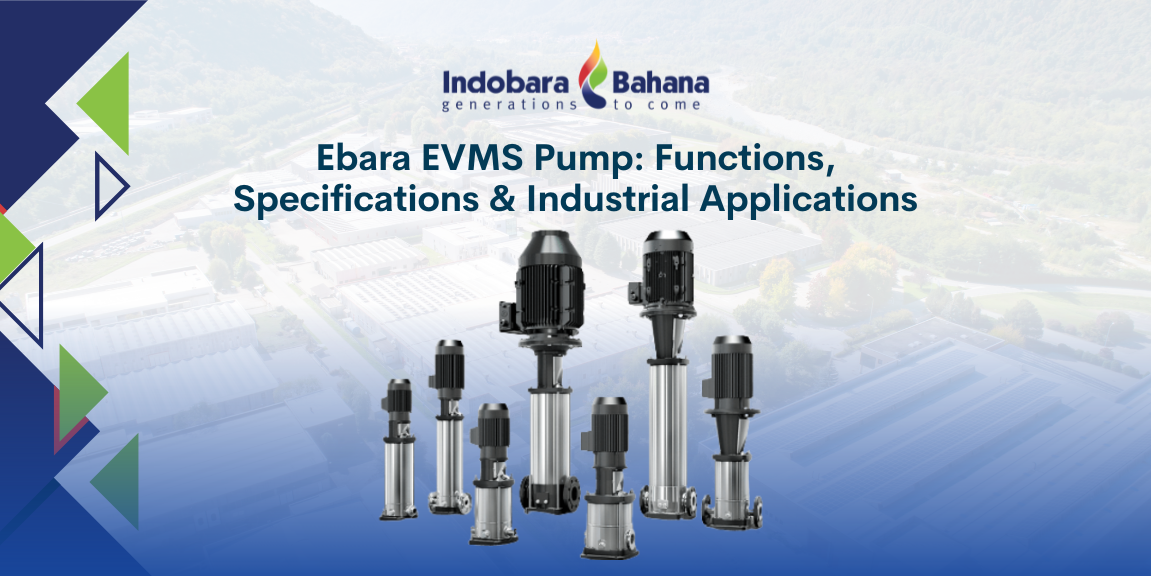
Unstable water pressure can disrupt daily operations, whether in a high-rise building or an industrial facility. If the water supply cannot maintain the required pressure and flow, equipment performance and overall system efficiency may be affected. Choosing the right pump is essential to keep water distribution systems running efficiently. One option is the Ebara EVMS pump, a vertical multistage centrifugal pump designed for applications that require reliable water flow and pressure.
The Ebara EVMS series supports various applications, including pressure boosting, water treatment, and industrial cooling systems. But how does it work, and what should you consider before choosing a model? This guide explains its functions, technical specifications, material options, and key features to help you find the right pump for your system.
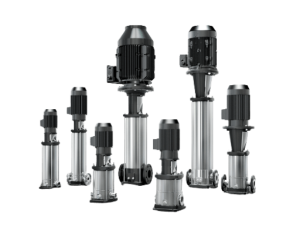 The Ebara EVMS pump is a vertical multistage centrifugal pump designed to transfer liquids and meet specific pressure requirements. The term multistage means that the pump uses multiple impellers arranged in stages to generate the required head. Its vertical configuration places the motor above the pump assembly, making it suitable for various building and industrial installations.
The Ebara EVMS is a non-self-priming, in-line centrifugal pump. This means the pump must be properly filled with liquid before operation, while its suction and discharge connections are arranged in line with each other. The EVMS series comes in ten nominal flow rate sizes, ranging from 1 to 90 m³/h. This variety allows users to select a model based on the flow and pressure requirements of their systems.
The Ebara EVMS pump is designed for more than general water distribution. It supports a wide range of applications in commercial buildings, water supply systems, and industrial facilities. One of its main applications is pressure boosting, which helps increase water pressure in piping systems. This is particularly useful in high-rise buildings, hotels, and industrial facilities where water must reach different distribution points at the required pressure.
According to the official Ebara EVMS databook, the pump series supports several applications:
These applications have different operating conditions. Therefore, selecting an EVMS model requires careful consideration of the liquid properties, required flow rate, operating pressure, and pump materials.
A centrifugal pump uses a rotating impeller to transfer mechanical energy to a liquid. In a multistage pump, several impellers work in sequence to generate higher total head. The process begins when liquid enters the pump through the suction inlet. It then passes through multiple impeller stages, where the rotating components transfer energy to the liquid.
As the liquid moves through these stages, the pump develops the head needed to deliver it through the discharge outlet. This multistage design allows different pump configurations to meet various pressure requirements. However, a pump with more impeller stages is not automatically the best choice. The required flow rate, total head, and actual operating point must still be evaluated.
For the Ebara EVMS pump, these relationships are shown in the performance curves provided in the official databook. These curves help users identify which model can operate within the required system conditions.
Understanding the technical specifications is an important step before selecting an industrial pump. The Ebara EVMS series is available in ten nominal flow rate sizes: 1, 3, 5, 10, 15, 20, 32, 45, 64, and 90 m³/h. The following table summarizes the main specifications listed in the Ebara EVMS 50Hz databook.
| Parameter | Specification |
|---|---|
| Pump Type | Vertical multistage in-line centrifugal pump |
| Nominal Flow Rate Sizes | 1–90 m³/h (10 nominal sizes) |
| Maximum Working Pressure | 16–35 bar, depending on the model |
| Liquid Temperature Range | -30°C to +140°C, depending on configuration and manufacturer requirements |
| Material Options | Cast Iron, AISI 304, AISI 316L |
| Motor Frequency | 50 Hz |
| Minimum Efficiency Index | MEI > 0.7 for all model sizes |
| Pipe Connections | Flange and other connection options, depending on the model |
The temperature range above represents the limits specified in the product databook. It does not mean that every model can operate throughout the entire range. For operating temperatures between -30°C and -15°C or between 120°C and 140°C, Ebara advises users to consult the manufacturer.
The maximum working pressure also varies by model. EVMS sizes 1–20 are available with configurations rated up to 25 bar, while sizes 32–90 include configurations rated up to 35 bar. For this reason, always check the specifications of the exact pump model rather than relying only on the general EVMS series specifications.
Besides flow rate and pressure, the Ebara EVMS pump series offers three material versions: EVMSG, EVMS, and EVMSL. The main difference lies in the materials used for the pump components.
The EVMSG version uses cast iron for the bottom casing, while several hydraulic components are made from AISI 304 stainless steel.
The standard EVMS version uses AISI 304 stainless steel for its main hydraulic components and casing, according to the specifications of each model.
The EVMSL version uses AISI 316L stainless steel for its main hydraulic components, including the impeller and casing.
Choosing the right material depends on the type of liquid being pumped and the operating environment. For applications involving liquids with specific chemical or temperature characteristics, material compatibility and mechanical seal selection should be confirmed before choosing a model.
Energy efficiency and maintenance accessibility are important considerations when choosing a pump for continuous building or industrial operations. The Ebara EVMS series includes several features designed to address these needs.
All EVMS model sizes have a Minimum Efficiency Index (MEI) greater than 0.7, as specified in the official databook. The series is also available with IE3 efficiency motors for the applicable motor power configurations.
In addition, the Ebara EVMS supports the use of a Variable Frequency Drive (VFD). This allows motor speed to be adjusted according to system requirements. For example, a properly configured VFD and sensor can help maintain the required pressure when operating conditions change.
The EVMS series features a cartridge mechanical seal design that allows shaft seal replacement without dismantling the motor bracket. Certain configurations also include a spacer coupling, making maintenance easier without removing large motors. These features can simplify access to components during maintenance.
Depending on the model, Ebara EVMS pumps are available with different pipe connection options. These include round flanges, oval flanges, loose flanges, and other connection types specified in the databook. This flexibility helps users select a configuration that fits the requirements of an existing or new piping system.
Selecting the right pump involves more than checking its motor power or nominal capacity. Two of the most important parameters are flow rate and head. Flow rate refers to the volume of liquid a pump delivers over a given period. It is commonly measured in cubic meters per hour (m³/h) or liters per minute (L/min). Head represents the energy the pump provides per unit weight of liquid and is usually expressed in meters.
For example, a water distribution system in a high-rise building must account for the building height, required pressure at the point of use, and pressure losses throughout the piping network. Once the required flow rate and total head have been calculated, they can be compared with the Ebara EVMS performance curves. These curves show the relationship between flow rate, head, efficiency, power requirements, and Net Positive Suction Head (NPSH) for each pump model.
The official Ebara databook recommends considering an NPSH safety margin of at least 0.5 meters during pump selection. It also advises against operating the pump at a flow rate below 10% of its Best Efficiency Point (BEP) flow rate to reduce the risk of overheating. By evaluating these parameters, users can choose a pump based on actual operating conditions rather than maximum capacity alone.
Regular maintenance is important for keeping a pumping system operating within its intended conditions. One component that deserves attention is the mechanical seal, which helps prevent liquid leakage around the pump shaft. The Ebara EVMS uses a cartridge mechanical seal system with different seal material options depending on the operating conditions and pump configuration.
According to the databook, available seal configurations include materials such as silicon carbide, carbon, EPDM, and FPM. The cartridge design simplifies seal replacement because the motor bracket does not need to be dismantled. However, maintenance should always follow the appropriate procedures for the installed pump model.
Users should also ensure that the pump operates within its recommended flow, temperature, and pressure limits. For mechanical seal replacement, component inspection, and maintenance intervals, refer to the official operation and maintenance manual for the specific pump model.
Choosing the right pump is not just about comparing specifications. It is also about making sure the selected model matches your system’s flow rate, pressure, and operating requirements. At PT Indobara Bahana, we help customers find suitable Ebara EVMS pump solutions through technical consultation and product selection support.
With experience serving industrial and commercial applications, we can help you identify a suitable pump for pressure boosting, water treatment, and water distribution systems. Explore the Ebara EVMS pump options available through PT Indobara Bahana and find a solution that matches your operating needs.
Not sure which model is right for your application? Contact us on WhatsApp to discuss your requirements and get product recommendations tailored to your system.
Ebara Pump Spare Parts and Ebara Pump Service at Indobara
Indobara provides two main solutions for maintaining Ebara pumps: Ebara pump spare parts and Ebara pump service. These services can be used separately or together, depending on the condition of the pump and the customer’s requirements. If you already know which component needs to be replaced, you can order the required spare part directly. However, […]
See Details
Water Leak Detection: Types of Equipment and How to Detect Water Pipe Leaks
Water leak detection helps locate leaks in piping systems that are difficult to identify visually, especially in underground pipes, concealed areas, or extensive water networks. With the right method and equipment, leak locations can be investigated more accurately before repair work begins. Choosing the right water leak detector is equally important because every piping system […]
See Details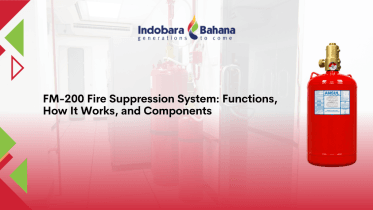
FM-200 Fire Suppression System: Functions, How It Works, and Components
The FM-200 Fire Suppression System is a clean agent solution used to protect electronic equipment and high-value assets. In server rooms, communication centers, or control rooms, choosing the right extinguishing agent is important because particles and oily deposits can increase cleanup requirements and interfere with the protected equipment. This system uses a gaseous clean agent […]
See DetailsNeed the right engineering solution for your project? Our expert team is ready to provide insights and the best recommendations. Send us your questions, and we’ll get back to you soon.


